Showing posts with label Public Gardens. Show all posts

Tuesday, June 3, 2014

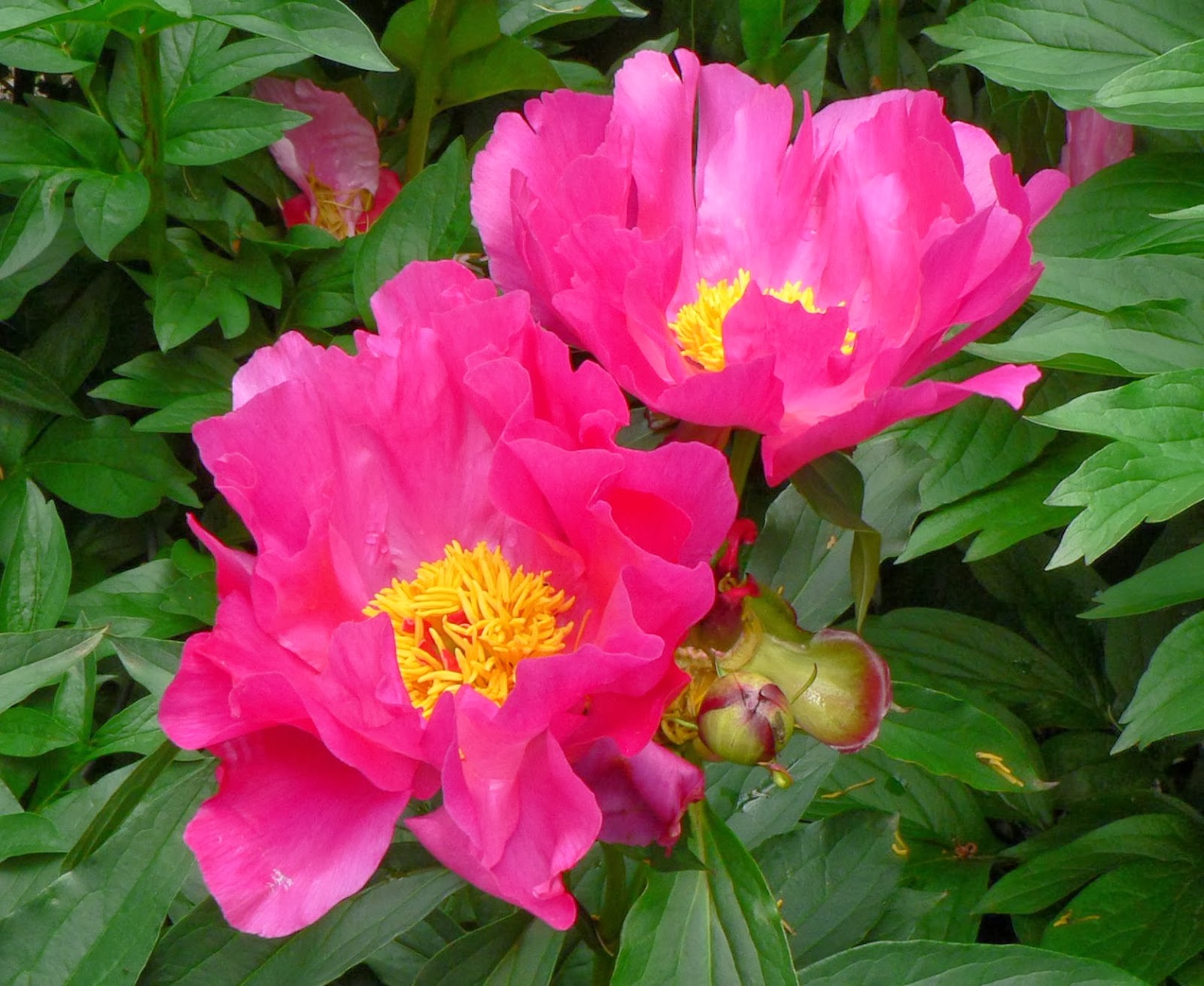
Tree Peony 'Toichi Ruby'

I encountered this incredibly beautiful tree peony on a recent visit to Olbrich Botanical Gardens.

Tree peony 'Toichi Ruby'


This is a relatively recent introduction, hybridized by Toichi Domoto and Roy Klehm. The color is just fantastic, and the flower form and presentation on the bush are also excellent. (The color is coming out more pink in the pictures - in real life it appeared to be more of a delicious cherry-pop red.)

Tree peony 'Toichi Ruby'


It appears to be a very profuse bloomer. I'm not sure how old these plants are, but this section of Olbrich has only been installed in the last couple years, so they can't be at full maturity yet. I took about 3000 pictures of it. :-)

Tree peony 'Toichi Ruby'


As a bonus, they had a light but very beguiling sweet fragrance, reminiscent of old garden roses. Unusual for what seems to be a (typically scentless) Japanese type of tree peony! I wonder if it has some Chinese/rockii in its blood...

Tree peony 'Toichi Ruby'


By far my favorite tree peony in Olbrich's collection to date - they have several others (see my earlier post about them), most in various nauseating shades of mauve. With its strong bright color, 'Toichi Ruby' would have to be placed with care in the garden - but I'd personally be willing to banish anything that clashed to another part of the yard to accommodate this diva!

Monday, May 19, 2014

Woodland Wildflowers at Olbrich

I took a stroll through Olbrich Botanical Gardens today and the spring-blooming woodland wildflowers were in full bloom. (It was a rather overcast day, so the lighting is a bit gloomy in these shots I'm afraid.)

Ferns with Virginia Bluebells and Canada Wild Ginger

Trillium lutea - I personally like this subtly-colored trillium more than the more typical glaring white one. It is quite a sizeable plant as well.

Trillium lutea with ferns and wild ginger

Mertensia virginica (Virginia Bluebells) here with Stylophorum diphyllum (Celandine Poppy), planted in great sweeps under white birch.

Mertensia virginica (Virginia Bluebells) and Stylophorum diphyllum (Celandine Poppy)
Wildflowers look best when planted in broad swathes, and Olbrich has the space to do just that. Here is an underplanting of Celandine Poppy, tousled by the spring breeze. I do not have it in my garden, but am given to understand that it is a major spreader (by seed), although perhaps not too difficult to manage.

Stylophorum diphyllum (Celandine Poppy)

Primula veris (Cowslip primrose) looking cute at the foot of a tree, with a hellebore peeking over its shoulder. I like any kind of primrose, but the little wildlings are especially elegant.

Primula veris (Cowslip primrose)

They had several large fields planted up with little species tulips, grape hyacinths, and daffodils, interspersed with grass. The effect was just lovely - fields of bulbs as far as the eye can see.

Field of bulbs

This old Downy Hawthorne (whose gnarled, twisted branches are being supported in places by wooden posts) is underplanted with what looks like "regular" green brunnera, as well as silver-leaved cultivars. A fine effect as they bloom together.

Crataegus mollis (Downy Hawthorne) and Brunnera

OK, so these are not exactly "wildflowers" but a fabulous woodland planting nonetheless: epimediums, hostas, daffodils, and astilbe under mature trees.

Epimediums, daffodils, hostas, astilbe, allium

As usual, Olbrich does not disappoint!


Thursday, January 2, 2014

Mid-season Peonies at Olbrich

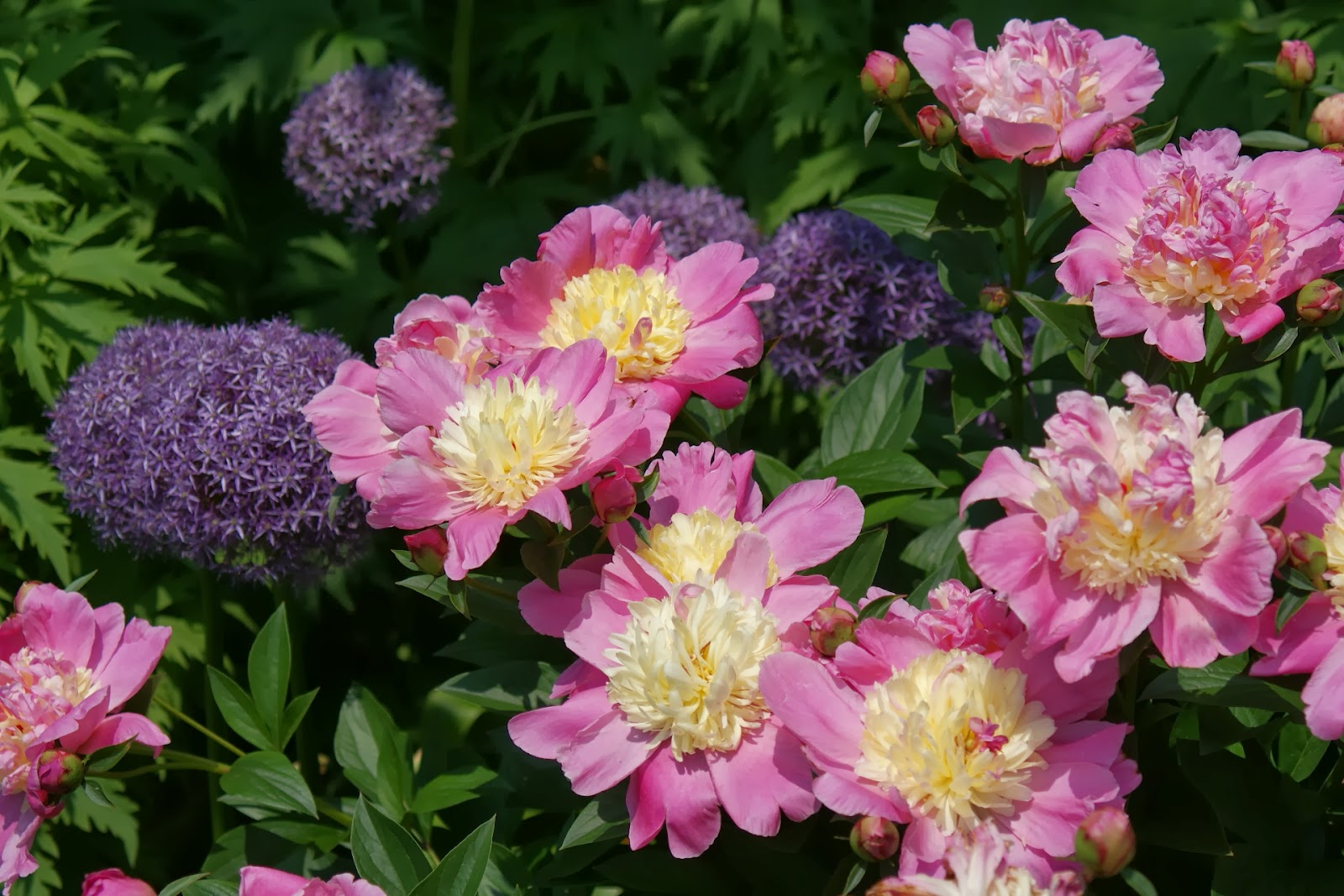
I am very behind in my postings! Let's start getting back on track with some memories of mid-season peonies at Olbrich Botanical Gardens. Olbrich has a fantastic peony collection, with lots of unique selections from Klehm's Song Sparrow. These photos were all taken in early June.

Beautiful Senorita - this striking Japanese type has strong pink petals and fabulous spiky centers.

Herbaceous peony 'Beautiful Senorita'

Fuchsia Jazz - the shape of this herbaceous cultivar is almost tree-peony like. As you can see, eye-popping color!

Herbaceous peony 'Fuchsia Jazz'

Bowl of Cream - one of those super-packed doubles I am so fond of. A very good white with strong fragrance. Seemed to have pretty strong stems for such an enormous flower.

Herbaceous peony 'Bowl of Cream'

Fluffy - I like Fluffy although the name is perplexing. It's not particularly "fluffy" at all - perhaps they had in mind the gold poof at the center. The petal edges are nicely fringed.

Herbaceous peony 'Fluffy'

Coral Supreme - this is one of those WOW peonies. I love coral peonies in general. It would be hard to choose a favorite between this one and 'Coral Sunset'. The dark coral pink slowly fades to apricot-cream. The gradations of color, floriferousness, and overall plant habit make a breathtaking show in the garden. I took about 18 pictures of this one... here are a couple for you!

Herbaceous peony 'Coral Supreme'


Sweet Shelly - another nice Japanese type, this one with very large soft yellow centers, and short, flat pink petals.

Herbaceous peony 'Sweet Shelly'


Karl G. Klehm - the flowers on this rose-shaped creamy white peony are simply enormous and heavily double. I love the antique look of the blooms, but as you can see the flowers are so heavy they droop seriously - the plant really can't hold itself up at all. The plant in the picture is well-supported, but still the stems fall and weep.

Herbaceous peony 'Karl G. Klehm'


Flame - the picture here does not do this peony justice - the color is an indescribable coral-red, which really does seem to burn with a mysterious inner fire. It was also growing, for some reason, in what appeared to be nearly complete shade. The color carries across the garden amazingly well, and from a distance it appears like a stand of enormous but delicate tulips.

Herbaceous peony 'Flame'


Pink Luau - I remember not liking this peony when I saw it... but the picture sure does look attractive. Certainly a unique peony, perhaps more effective as a close-up than for garden effect.


Hope you've enjoyed my memories of June... Visiting Olbrich is always so torturous - if only I had endless space to add more peonies to my garden!

Sunday, September 30, 2012

Fall Afternoon

My family went for a sunny fall stroll in the Arboretum this weekend. We saw some stunning fall color, as well as migrating geese, chipmunks, and a little striped snake. Here are some visual highlights:

View over prairie

Native plant garden

Shrub Garden

My daughter gathering leaves for a collage


Sumac

White birch glowing at the forest edge

Sunday, June 3, 2012

Explorer Roses at Olbrich

It was rose season during my most recent visit to Olbrich Botanical Gardens - hooray!
Roses with allium, catmint, heuchera, geranium
I missed the rugosa display this year (bleepers!), but I did catch the shrub roses in their full glory. The ones that impressed me the most were the ultra-hardy Canadian Explorer series of roses. They all looked so healthy and abundant! I love the flowers of any rose, but many have awful foliage and awkward shapes. The Explorers all looked great.

George Vancouver was perhaps my favorite. I had not seen this one before and found it arresting. The flowers are a brilliant coral red color - a wonderful glow in the garden!

Explorer rose 'George Vancouver'
 It is a relatively small plant with a tidy habit. Here it is in a mixed border with willow and geranium.

Explorer rose 'George Vancouver' with Salix integra 'Hakuro Nishiki' and geranium
John Davis is my other favorite - this one is gigantic. It looks like it emerged from a fairy tale. At Olbrich they have lots of these growing up through enormous tuteurs. Here it is intermingling with an unlabeled clematis. This specimen was at least 8 feet tall - this is a close-up of its mid-section!

Explorer rose 'John Davis' with clematis
Here it is growing alone, in a mixed planting with catmint, tiarella, allium 'Globemaster', and other delights. This specimen is much smaller than the others I saw - not sure if it's just younger or if they prune this one back drastically to squeeze it into the space. Either way, as you can see it makes a very dense bush smothered in full double blooms.
Explorer rose 'John Davis'
William Baffin is an Explorer that is planted often up here - and it is a happy, healthy thing for sure! The individual blooms are not very fine on close inspection, but the overall effect is breathtaking when this tall climber blooms. At Olbrich they have several of these planted around the stone arches at the base of their beautiful rose tower.

Explorer rose 'William Baffin'
I want to plant more roses in my garden (if I can ever remove the gigantic gravel pit from the only remaining sunny spot in my yard... long story). I think I will have to make room for an Explorer or two!

Saturday, April 28, 2012

Spring Foliage Combos at Olbrich

Mixed border at Olbrich in late April including barberries, roses, lamb's ears, daylilies, ajuga
Olbrich Botanical Gardens is a wonderful resource for gardeners. I hadn't been there for several years, and discovered on a recent trip that they've expanded and made quite a few improvements! On this trip I focused on seeking out pleasing spring foliage combinations. They definitely have a thing for colored foliage at Olbrich. Here were a few of my favorites:

Barberry 'Crimson Pygmy', Stachys byzantina (lamb's ears), Alchemilla mollis (lady's mantle)
I love the foliage, habit, and color variety of barberries. Purple-colored varieties like this 'Crimson Pygmy' look great with lamb's ears at their feet. There is contrast in color, leaf shape, and texture. I liked the addition of lady's mantle in this little scene - the mid-green helps bridge the sharp contrast between purple and silver, and adds yet another leaf shape.

Epimedium with Thuja occidentalis 'Hetz Midget'
This was one of my favorite combos of the day: the heart-shaped leaves of epimedium contrast with the filigree foliage of the Thuja. Both greens have an olive-chartreuse cast at this time of year.

Heuchera 'Brownie', Hosta 'Amber Tiara', Hakonechloa 'All Gold', Helleborus orientalis, Leucojum
There is so much that I love about this scene - the contrasting leaf shapes of heuchera and hakonechloa, the glowing gold against green, with a ribbon of reddish brown strung through the middle, how the the hellebore flowers highlight the purplish tones in the heuchera. I even like the wispy note added by leucojum here - a plant that's normally too "messy" looking for my taste.

Hosta 'Sun Power' with Boxwood
I found this combo of large lime-green hosta leaves and small darker green boxwood very pleasing. The hosta picks up on the color of the new growth on the boxwood.

Carex flacca and White Birch
These white birch trunks emerging from a sea of Carex flacca made a simple but wonderful woodland scene.

Dryopteris, Mertensia virginica, Podophyllum
Another woodland planting contained a jumble of ferns, Virginia Bluebells (Mertensia virginica), and May-apple (Podophyllum). There is also some Canadian Wild Ginger (Asarum canadense) in the foreground. I think it's the large-textured podophyllum foliage that keeps this combo from looking scruffy or busy.

Tree peony, Iris cristata, Japanese maple
The spiky, simple shape of Iris cristata looks great under the large, intricate tree peony leaves. (I love tree peony foliage - although some people apparently find it dull.) The Japanese maple overhead adds height and color contrast. I think this combo would look nice even when nothing is in flower.

Corydalis, Astilbe, Ligularia
I kept seeing this golden-leaved astilbe planted here and there about the place and doing a double-take - What IS that thing? OH right - a yellow astilbe! One can certainly go overboard with the yellow, but here it makes a not-too-nauseating spot of shininess among shades of green.

Petasites japonicus 'Giganteus' and golden Juniper
Petasites was a new plant for me, and it certainly made a good first impression with its large-textured leaves and funky-looking purplish spiky flowers! It was growing near a rocky stream, so may be a moisture lover. The golden juniper makes a fine companion.

I found lots of good ideas for foliage companions in my own garden - definitely a rewarding trip!

Friday, April 20, 2012

Lilacs at the Arboretum

It's lilac time here in Wisconsin, so of course... off to the Arboretum I go!

Lilacs blooming at the Arboretum

The UW-Madison Arboretum has an awesome collection of hundreds of lilacs in all shapes, sizes, and colors. The mid-season lilacs would normally bloom here in May, but in this odd year of 2012 are at their peak in April. Here were some of my favorites - these are all cultivars of syringa vulgaris (aka common lilac or French lilac).

Syringa vulgaris (common lilac) 'Henri Martin'
My favorite color of lilacs is... well - lilac! 'Henri Martin' has big beautiful double flowers in a rich shade of that classic lilac color. I gave each lilac a sniff as I strolled through the gardens, and I noticed that not all lilacs have the same fragrance. Some have a flat, almost unpleasant scent, and some have no detectable fragrance at all. 'Henri Martin' had the sweetest, most powerful fragrance of all I encountered - my nose wanted to live in this flower!

Syringa vulgaris (common lilac) 'Paul Deschanel'
I also really love the dark purple cultivars. I saw quite a few standouts - 'Declaration', 'Prince Wolkonsky', 'Yankee Doodle'. 'Paul Deschanel' had gorgeous mulberry colored buds and was perhaps my favorite in this color class.

Syringa vulgaris (common lilac) 'Marie Frances'
There are not many pink lilacs. Some that are called "pink" are really more of a pink-ish violet color. 'Marie Frances' had true pink flowers of an otherworldly delicate beauty.

Syringa vulgaris (common lilac) 'Mount Baker'
White lilacs can be very elegant. 'Mount Baker' and 'Edith Cavell' were my favorite whites, but 'Mount Baker' had a much more powerful fragrance. The bush was absolutely covered with exuberant blooms.

Syringa vulgaris (common lilac) 'Primrose'
There are no truly yellow lilacs, but 'Primrose' is a soft cream color with yellowish buds. It's a nice soft color for a spot where pure white might be too harsh or glaring. It sets off other more traditionally colored lilacs nicely.

Syringa vulgaris (common lilac) 'Martha Stewart'
I loved the cool gray-blue shade of this 'Martha Stewart' lilac. This is also an unusual color in lilacs.

Syringa vulgaris (common lilac) 'Emile Lemoine'
'Emile Lemoine' is a gorgeous lilac - full soft double flowers of a pearly pinkish lavender. It just looks so French, doesn't it?

There were dozens more beauties, and I probably only managed to see 1/3 of the vast collection... I returned home to my own lilac, looking so ordinary and unexotic there all by himself in the corner of my yard... But even the basic syringa vulgaris var. purpurea puts on a great show, and it actually has a more powerful scent than most cultivars!

My own lilac - basic syringa vulgaris var. purpurea

Related Posts Plugin for WordPress, Blogger...