Showing posts with label Annuals. Show all posts

Monday, July 15, 2013

July Blooms

July is probably my least favorite month of the gardening season. The heat of July is such a drag, I really lose all desire to go outside. Also, most of my favorite flowers bloom in April, May, or June, with a few August/fall bloomers thrown in for good measure. When it comes time to decide whether to put a peony or a coneflower in a particular spot, the peony wins for me every time. But, I've been making a concerted effort combat the July desert effect in my garden.

Caryopteris, Euphorbia 'First Blush', and Lamb's Ears
It's a "between" time in my garden right now. The roses and clematis are in the lull following their first flush of bloom, Asiatic lilies are on their way out and Orientals are not quite on their way in. At this time I enjoy foliage and subtle flowers in my garden, like the combo in this corner of my peony bed. The flowers of Lamb's Ears and sedum album (in the background) are not standouts, but they create nice points of interest during this quiet time.

Achillea 'Saucy Seduction'
A few perennials are putting on a bright show. The color of achillea blooms really pops, and I also love the ferny foliage.

Stokesia 'Purple Parasols'

Perhaps my favorite July bloomer, Stokesia, is looking fine right now. Those giant purple orbs make me forgive its somewhat floppy habit and dull foliage.

Kalimeris incisa 'Blue Star'

This kalimeris (Japanese False Aster) is also growing on me, with its simple charm and easy care. It's like an aster, but needs no division, doesn't get mildew, and blooms from July til frost. The flowers are a very pale steel blue, although they look washed out in sunlight and in my photograph.

Nasturtium

I've planted a few annuals here and there to liven things up for the summer. These orange nasturtiums make a cheery contrast with the chartreuse foliage of Tanacetum vulgare 'Isla Gold' in my orchard area. A newly planted blue agastache behind has yet to bloom.

Pentas near Siberian Iris, Lemon Thyme, and Damask Rose

I popped some red pentas in throughout the patio bed, to live up the area that earlier was lush with iris, campanula, and rose blossoms. Hummingbirds seem to love pentas so I make sure to get some every year.

Marigold 'Zenith Red' with Physocarpus 'Coppertina'

My favorite area of the garden right now is the back hedge. The orange marigolds are blooming strong, and the 2-year old shrubs are starting to fill in a bit. Also, I have finally painted the fence back here! This is what it used to look like:

Back hedge before fence painting
And here it is now! I think it's a big improvement.

Back hedge with newly painted fence


The hypericum (St. John's Wort) 'Ames' to the left of the arborvitae has now begun to bloom. It is still small, but recovering pretty well from last year's rabbit attacks (which prompted the ugly chicken wire you can see in the photos). It has pretty, blue-green foliage reminiscent of willow, and bright lemon yellow flowers.

Hypericum kalmianum 'Ames'


One last long view of the back hedge:

Hypericum 'Ames', Thuja 'Smaragd', Heuchera 'Miracle'
Head on over to May Dreams Gardens for Garden Bloggers' Bloom Day to see how other people battle the July doldrums!

Monday, July 9, 2012

Summer Annuals

Well, the relentless stretch of insane 100+ degree temperatures has finally broken, and I can finally venture out into the garden again without fear of melting my camera (or myself)! Wisconsin has not seen such hot temperatures since the 1800s. The plants, like the people, are looking tired and worn, but happy to have survived. And through it all, was I doomed to contemplate only parched grass and resting perennials from the windows of my air-conditioned refuge? I was not! Because I had the foresight to sprinkle the garden with a variety of tough summer blooming annuals. Here is what continued to bloom through the broil:

Snapdragons (Antirrhinum majus) - I've always read that snaps prefer cool temperatures, but these 'Ribbon' series snapdragons that I grew from seed bloomed non-stop right through the heat. (I did water them, of course.) They looked so enticing, they ALMOST made me want to venture outside to pick a bouquet (almost).

Snapdragons 'Ribbon Mix'
Calendula (pot marigold) is an easy annual for summer color. If deadheaded, it blooms continuously from June to frost and beyond (October or November in my area). It's incredibly easy to grow from seed, directly sown right where you want it. This year I planted a cute little dwarf variety called 'Bon Bon'. Calendula are edible (and quite tasty), so I was concerned that the local bunnies wouldn't give them a chance, but for some reason this year they went after the zinnias and left the calendula alone. Go figure.

Calendula 'Bon Bon' with Snapdragon 'Ribbon Mix'
Petunias are of course a classic favorite for providing summer color through the hot months - here is 'Wave Pink' at the feet of Balloon Flower (Platycodon grandiflorus) 'Mariesii':

Platycodon grandiflorus 'Mariesii' and pink Wave petunias
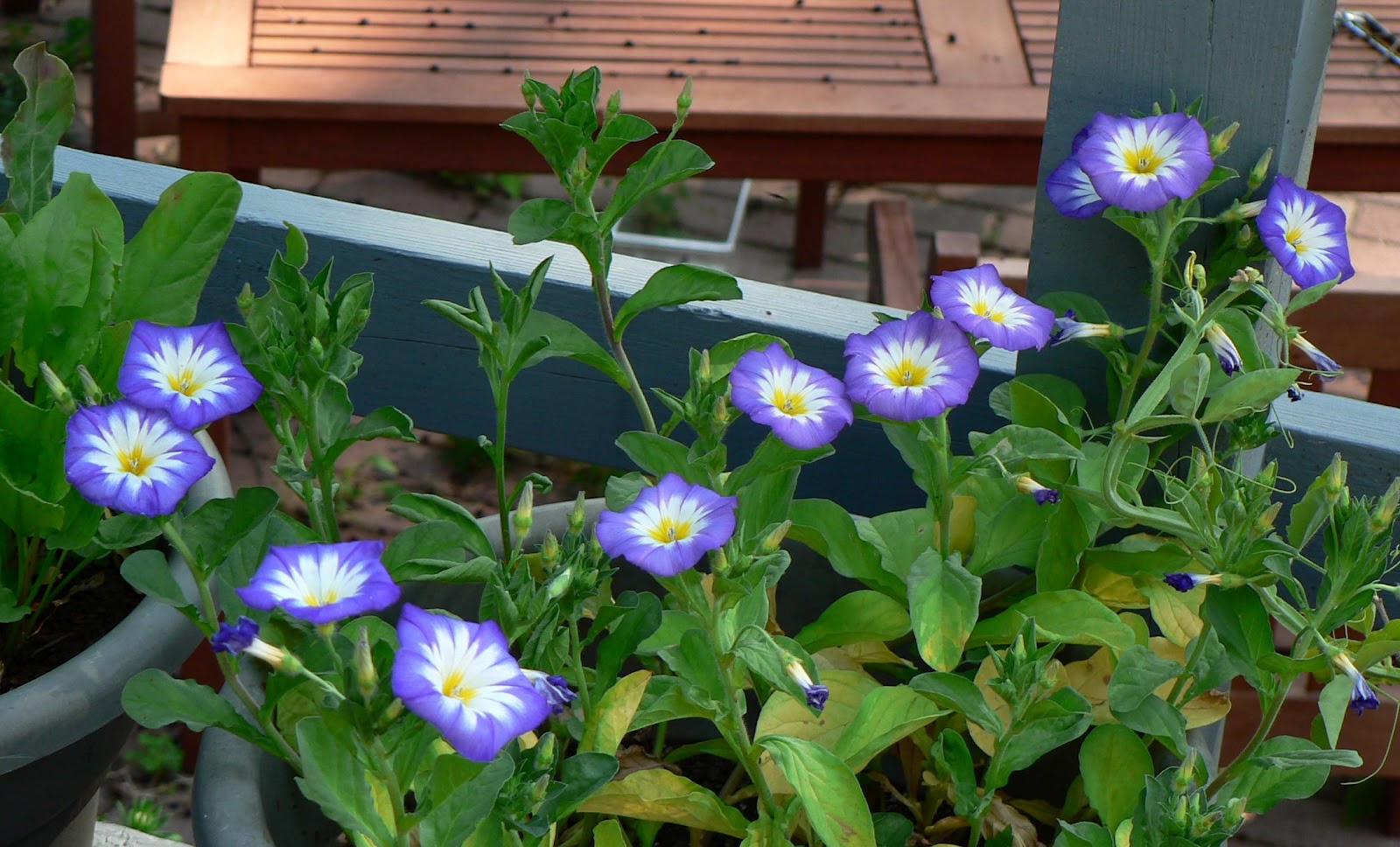
I grew this Convulvulus tricolor (Dwarf Morning Glory) from seed and it churned out pretty new blue-and-yellow blooms every day through the heat wave. The foliage looks pretty awful though - not sure if it needs a richer potting soil, more water, or less heat (probably all three).

Convulvulus tricolor (Dwarf Morning Glory)

This Martha Washington Geranium (Pelargonium) is an African plant that does not mind the heat. It sucked up water like a sponge, so I did have to water it every day. Annual geraniums need to be deadheaded and deadleafed (remove dead/yellow leaves) continually to keep them looking spiffy.

Martha Washington Geranium
I planted canna and calla lily bulbs, and so far only the callas are blooming. They are also getting ravaged by Japanese beetles (which we have here in droves) - my daughter and I will resume our daily round with a cup of soapy water now that the heat has waned. These bulbs create a tropical atmosphere which is certainly appropriate to the weather this summer!

Calla lilies (blooming), with canna and penstemon foliage

I'm quite happy with this quiet little diascia which I picked up on a whim - it has been blooming non-stop since June, and together with the lamb's ears provides a cooling touch to this hot spot near pavement.

Stachys byzantina and Diascia


Tuesday, April 10, 2012

Seed Starting

I start many vegetable and flower plants from seed indoors. Indoor seed starting is easy to do, saves money over buying transplants, and it also allows me to start "gardening" in late winter, when I can't wait to start playing with dirt again! The picture below shows one of my flats with coleus, amaranth, cutting celery, convulvus tricolor, Thai and Genovese basil, tomatoes, and parsley from this spring.
Seedlings growing in Jiffy-7's and fiber pots
Containers

There are many different types of containers and growing media that can be used for seed starting. Debates over which method is best can get heated, but in my experience as long as you have enough light, water, and the correct temperature, plants will grow quite happily in pretty much any container and growing medium. I personally like to use Jiffy-7's to start my seeds, because I find that they save me time. Jiffy-7's are small discs of compressed peat, encased in a small mesh bag. You soak the peat discs in warm water for about 30 minutes, and they expand into small cylinders. I like these little guys because:
  1. It's difficult to mess up the watering with peat. Peat is a very absorbent material that will hold a lot of water, while also allowing plenty of oxygen between the fibers. Despite the fact that the peat cylinders are tiny, you can water only once a week or so. The containers will not dry up suddenly without warning, and there is also little chance of the roots drowning due to overwatering.
  2. The plants' roots grow right through the mesh bags. If you use a container with hard, impermeable sides (like plastic), when the roots reach the edge of the container they will begin to circle, which is not good (they will continue growing along this circular trajectory even when freed from their container). You can prevent this by being super-vigilant and transplanting to a larger container before it happens (totally unrealistic for me!), or by scoring the roots after you take them out (can get to be a lot of work). With a root-permeable container this is not an issue. The roots of the plants all grow into each other, and some roots will inevitably be torn when you remove one from the flat. This is perfectly fine - a bit of root pruning encourages new growth.
  3. No need to fill with potting soil. Just plant right into the cylinders. Eliminating the soil filling step saves an amazing amount of time when you're planting a lot of containers.
  4. Transplanting is quick and easy. Just pop the entire container right into the garden soil. Planting out a large flat goes very quickly when you don't have to remove each plant from its individual container.
Marigold seedling with roots growing through container
You can also achieve great results by planting in large open flats with no divisions, or using homemade newspaper pots or individual peat pots filled with potting soil. But these options will mean a bit more work.
 
Lighting

Vegetable and most annual flower seedlings need at least 11 hours of bright, direct sunlight a day. It is impossible to get the necessary amount of light with even a bright south-facing window. Without supplemental lighting your seedlings will be leggy and weak. I have a simple setup with LED grow lights and metal grid shelving. Fluorescent grow lights can also be used. Fluorescents are cheaper to buy initially, but use more energy and are thus more expensive to run than LEDs. (I'm not sure which one ends up being cheaper in the long run, but both work.) Fluorescents get very hot, so must be kept further from the plants than LEDs. The LEDs emit a weird-looking purple glow (my neighbors must think I'm doing some kind of mad scientist), but the plants seem to like them. You want to position your plants so they will receive as much natural light as possible, in addition to your artificial lighting. I have mine in my sunniest window, and also keep the lights on for 11 hours per day.
Seedling flats growing under LED lights

Transplanting

Once the roots start growing out through the sides of the containers, it's time to either transplant out into the garden or into a larger pot. I use fiber pots which are also root permeable for this (see first picture above right), filled with any kind of potting mix amended with organic fertilizer. Before your plants go into the garden, they need to be hardened off so they get accustomed to the bright light and buffeting winds of the outside world. I harden off opportunistically - as soon as the seeds have germinated, any sunny afternoon above 50 F they spend a few hours on my deck. I always bring them in at night. Because they've spent so much time outdoors from a young age, my seedlings don't really need a strict "hardening off" schedule before going out.
Seedlings transplanted into garden - early April
I transplant tomato and pepper seedlings out early using Kozy Coats (the red thingies), but broccoli, lettuce, snapdragons, and parsley can go out unprotected rather early. For basil, marigolds, zinnias, cucumber, and squash wait until the danger of frost has passed. Peas, spinach, radish, carrots, beets, and beans are better direct seeded.

Lettuce 'Deer Tongue'
Before you know it, you'll be harvesting yummy veggies and enjoying an early flower display!

Marigold 'Favorite Red' with Basil

Sunday, February 26, 2012

UNfavorite Annuals

Earlier I took a look at some of my very favorite annuals to grow from seed. Here are some seed-grown annuals that are at the opposite end of the spectrum for me, for one reason or another.

Caveat: these flowers may be just fine in another situation, or perhaps if you know how to treat them right. They may in fact be on your list of favorites, and perhaps I am unfairly maligning them. Please don't be offended or arrest me for plant calumny - this is just my two cents based on my particular growing experience!

Cosmos

Cosmos 'Daydream' falling on squash
I'll start with Cosmos. I know this is a super popular annual to grow from seed. It does indeed germinate easily (just sow and grow), and the flowers are certainly pretty. The foliage is cool and ferny looking. HOWEVER - in my garden, the plants always get blown over just as soon as they barely begin flowering (if not before). This leads to lots of stem breakage, and a general ugly sprawling mess. Also, in my relatively short growing season they don't start to flower until mid-August. I kept growing cosmos for several years, hoping that the poor performance was just a fluke, and then finally gave it the ax.

Cosmos 'Sonata' also falling on squash, despite wooden supports intending to prevent this

Lavatera

Lavatera 'Mont Blanc' blooming for 4 minutes
Lavatera is an annual that gets praised to the skies in seed catalogs, and always looks stunning in the pictures. (I've learned not to trust most seed catalog descriptions by now, of course - liars!) The plant does indeed grow at a heart-stopping rate, quickly getting large and full of blooms. The flowers are big and abundant. HOWEVER, the plant has an insubstantial and cheap show-offy character that I find frankly irritating. And most importantly, as soon as blooming begins it gets some sort of wilt (?), the foliage turns lurid shades of yellow-brown, and the entire plant collapses in a heap. It looks like slime stew. Fortunately for your stomach, I have no pictures of the plant in this state. Here is a shot just before meltdown:

Lavatera 'Mont Blanc' about to melt (note poor condition of foliage)
As you can imagine, lavatera will not be joining us anymore.

Gomphrena

Gomphrena 'Woodcreek Lavender' with Zinnia 'Benary's Giant Salmon' (why?)
This one is totally unfair, but I was so traumatized (and embarrassed) by the combination of Gomphrena 'Woodcreek Lavender' and salmon zinnias in my garden one year that I cannot think of this plant without feeling nausea. (I made this photo EXTRA LARGE so you could enjoy it as well!) Of course, it's not the gomphrena's fault that its flowers are that color. I can't really justify this one, but I just don't like this plant. It looks like it has mauve pimples. And it had the gall to spoil my beautiful zinnia display.

Clarkia elegans

Clarkia elegans 'Appleblossom'
I absolutely love the other types of clarkias I've grown, but clarkia elegans was a real disappointment. Despite frilly pink double flowers (something which normally wakes up the 6-year old girl in me, who generally has the power to override whatever the rest of me is thinking), the ungainly mess of a plant habit caused my adult brain to get cranky and do a veto. It's hard to see in this awful photo, but the plant has branches that stick out in an awkward fashion every which way. The double flowers apparently come as a total surprise to the plant, causing it to fall over in astonishment. Foliage is not attractive and the whole thing looks vaguely weedy. The flowers, habit, and foliage have a kind of incongruity to them, as if the pieces were compiled from leftover bits of other plants. And perhaps most offensive: the flowers LOOK like they should be fragrant, but they're not! (how dare they?)

Bells of Ireland

Another annual that I will never grow again is Bells of Ireland, molucella laevis. This is what it looks like at first:
Bells of Ireland and annual Candytuft
 So architectural! Such classy green flowers! Stretching proudly towards the sky! I was thrilled enough with it to decide that the odor - which some apparently nose-damaged gardeners have likened to lemon - did not really bother me all that much. Well, as long as I stood quite far away while viewing it. And then it did this:
Bells of Ireland going crazy
The bottom half of the plant turns brown, the top half begins to twist and turn and fall all over the place. It is a 6-foot monster that crushes everything in its path. (It smothered my favorite clarkia!) So, I decided to hold my nose, get near it, and pull it out. By this point it has formed very thick, woody stems that are difficult to break off. It has surprisingly deep roots that resist my attempts to pull them. Naturally, it is also covered in thorn (a detail I had failed to notice before, since I was standing so far away from it). Worst of all, the smell - the awful smell of toxic industrial strength dish detergent mated with skunk - gets on your hands, your clothes, your hair. And will not wash off for days. It smells nothing like lemon, believe me.

So I decided never to plant this awful curse again. Only bad luck for me, because Bells of Ireland reseeds abundantly and widely, as any garden reference can tell you. (I actually do own many garden references and you would think I would consult them before planting something. Yet somehow, I still see a pretty picture in a seed catalog and think "The best way to find out about this plant is to scatter seed in the garden and just see what happens! No need to consult the wisdom of millions of gardeners who have gone before me - that would be a cop-out!") This was about five years ago, and every year since then I have been pulling stinky seedlings. Someone else has inherited my old rented community plot now - poor unfortunate soul! I will miss many things about that old familiar piece of ground - the loamy texture which I broke my back to achieve, the giant pile of free all-you-can-haul compost and leaf mold, the neighborly garden companionship. But molucella, I say goodbye to you with a smile.

Monday, February 20, 2012

Annual Poppies


Annual poppies are a quick way to add a splash of color to your garden. They are easy to grow from seed sown in situ. Like all poppies they do not like to be transplanted, but transplanting can be done when the seedlings are very small. They will grow, bloom, and die back within one growing season, and will often set seed and return on their own for years. Here are some of the annual poppies I've enjoyed growing:

Papaver somniferum - Opium poppy

Papaver somniferum 'Imperial Pink'
 Opium poppies have wonderful spiky blue foliage which is thick and cabbagey. They hold themselves up quite well for a poppy. Bloom time is extremely brief - the flowers will last only a week or two at most. However, the foliage is a fine addition to the garden in spring, and you can pull the plants out after bloom and replace with fall-blooming annuals if you like. These have the largest bloom size of any annual poppy.
Papaver somniferum 'Venus'

Papaver somniferum bud
Look at that fat bud!

Papaver rhoeas - Corn poppy/Shirley poppy

Papaver rhoeas 'Double Mix'
 Wild corn poppies are single and screaming red. They are a stunning sight in bloom and well worth growing in a wild area of the garden. There are also newer selections, like the ones on this page, which are double and come in softer colors. A seed-grown mix will give you a fascinating array of forms and shades, including interesting picotee and fade patterns. Here are a few examples from my garden:
Papaver rhoeas - red fading to white center

Papaver rhoeas - very double salmon pink

Papaver rhoeas - soft pink almost single

Papaver rhoeas - double white with dark pink picotee
Papaver rhoeas - double red

 The foliage of corn poppies is not as attractive as opium poppies. They will not fit into a super formal mixed border, but play pretty nicely with other "gentrified" wildflowers such as larkspur and salvia. They have thin stems and look best supported by a rustic wooden fence or a friendly neighbor. In their favor, the bloom time is definitely longer than opium poppies. Wintersown corn poppies in my garden bloomed for about 4-5 weeks, from mid-June to late July. (It helps if you deadhead, but some continuous bloom will occur even if you don't.) Later blooms will be secondary and tend to be more single. Fair warning: after bloom, the foliage looks just awful! The whole plant turns brown and dies back in a VERY ungraceful manner in August. If this bothers you, you can always pull them out after bloom and pop in some fall-blooming asters.


Eschscholzia californica - California poppy

California poppy 'Mission Bells'
California poppies are not true poppies, but they are a great little annual for the front of the border. They do not transplant well so you will probably not see them much at nurseries. The best and easiest way is to grow them from seed sown directly in the garden. Seed germinates easily and soon fills your garden with bluish green, filigree foliage. In my garden they bloom continuously right through the summer, from mid June until fall. You will drive yourself insane trying to keep up with the deadheading - astounding number of flowers! It's easier to just shear off the spiky seedpods once in a while when they accumulate. The wild California form is a glorious bright orange, but many cultivars are available too in a wide range of colors. Here are a few more I grew:

California poppy 'Jersey Cream'
 A soft creamy white double form. This one was not as floriferous or vigorous for me as other varieties for some reason. (I guess when they took the orange out, they took the kick out of him too!)

California poppy 'Purple Gleam'
'Purple Gleam' has bright violet pink single flowers on a taller plant. Bloomed like a mad thing.

California poppy 'Thai Silk Lemon'
Here is 'Thai Silk Lemon' looking perky in front of alyssum and morning glory. The soft yellow color blends nicely in the garden.

Thursday, February 9, 2012

Wintersowing Memories

This year's wintersowing containers are out on the deck, safely nestled in a blanket of snow. It will be a while before we see any action in there. So what's a gardener to do, stuck in the middle of dreary February? How about trawl through the photo archive for memories of wintersowings past...

Anchusa 'Blue Angel'
 Wintersowing is an easy and inexpensive way to grow perennials like this anchusa from seed, without having to worry about complicated and difficult seed treatments. If you haven't tried it yet, check out Wintersown.org for instructions and lots of tips. The basic idea is you plant seeds in deep soil in old plastic milk jugs or soda bottles, then put the containers outside during winter where they will be exposed to natural cycles of snow, frost, sunshine, and rain. The freeze-thaw cycles break the seed coat and produce excellent germination results. The seeds themselves decide when it's time to germinate, and they know what they're doing! After germination, you'll have lots of teensy little babies that look something like the below. (If your labels get rubbed off and you can't remember what's where, The Seed Site has an excellent database of seedling pictures for identification.)

Wintersown anchusa seedlings
Then you cut away the container and slice your soil like a wedding cake, and transplant out in the garden. The tops are tiny but the root system will be extensive. It is an easy and fun process, and best of all gives you an excuse to garden over the winter! Most perennials will not actually bloom their first year, although some will. The top picture of anchusa is from its first year - as you can see it bloomed nicely in year one. There is a great forum where you can ask wintersowing questions at the GardenWeb.

Here are some more past wintersowing successes:

Poppy 'Venus'
 I wintersowed lots of poppies, and this particular crazy puff-ball always attracted lots of attention. You can see the anchusa blooming in the background as well. This is an annual poppy, and I had just as much luck direct seeding annual poppies as with wintersowing, but you get more precise planting control with the wintersowing.

Stocks 'Vintage Red'
 Stocks are another annual I experimented with both wintersowing and direct seeding. I actually had much better success with wintersowing on these. I would do anything for that awesome fragrance!


Lupine 'Lulu'
 My favorite wintersown perennial was this lupine. This picture is from its 3rd year after wintersowing. It did bloom the first year, but not as much and the plants were much smaller. Sadly, I'm a bit too far south for lupines (not many times a Wisconsinite gets to say THAT!), so they only lasted 4 years in my garden before giving up the ghost. Lupines don't like humid summers at all, so that gorgeous foliage gets a bit tatty after blooming. I still think that blaze of glory is worth it - not bad for the price of one seed packet!

Phlox drummondii
Phlox drummondii is another annual that wintersowed better for me than direct seeding, for some reason. Here it is adding bright color to a planting of California poppies. Not my personal favorite plant because the foliage is kind of "Eh."

Hollyhock 'Queeny Purple'
I loved the purple color and large double flowers on this hollyhock, but as you can see here the foliage is already starting to look terrible. Hollyhocks always sound so good in theory, but in practice they are a bit of a mess. I've never seen one that didn't look as if it were being eaten alive. It did bloom in its first year though, despite being technically a biennial.


What joys will next year's containers bring...?
Related Posts Plugin for WordPress, Blogger...