Showing posts with label Shrubs. Show all posts

Saturday, February 14, 2015

Rose Garden in Autumn

I didn't specifically design this garden with Fall Color as the focus, but plenty crept in anyway.

Rose Garden in Fall: Cotinus coggygria 'Purple Cloak', Lamb's Ears, Euphorbia polychroma

The dark purple leaves of the Smoke Bush (Cotinus 'Velvet Cloak') gradually turn intense orange and red, and the nearby Cushion Spurge (Euphorbia polychroma) also colors up nicely. The Lamb's Ears are evergreen (or ever-silver) and continue to add color to the scene well past frost.

Euphorbia polychroma with Cotinus in October

I love the muted peachy-coral colors of the Spurge in Fall - this is one of my favorite four-season perennials.

Cotinus coggygria 'Velvet Cloak' in October

Cotinus foliage is colorful from Spring through Fall as well. I struggle to keep this fellow in bounds, as it wants to grow into a ginormous shrub/tree/monster. I cut it to the ground in spring, and still end up trimming it back several times a year. Highly worth it though for the color it provides.

Anemone 'Alice', Sedum 'Autumn Fire', and Austin Rose 'Sophy's Rose' in October

There are Fall flowers here too - double-flowered pink Japanese Anemone 'Alice' is a fall-bloomer, and it tumbles through the brick red florets of Sedum 'Autumn Fire'. In the background, reddish-pink 'Sophy's Rose' has a second flush of bloom in Fall.

Anemone 'Alice' with Sedum 'Autumn Fire'

Japanese Anemones are wonderful plants, but their tall flower stems do flop all about in an unmannerly sort of way. It looks best if with sturdy neighbors to lean on. Sedum performs this duty admirably.

Sedum 'Autumn Fire' in September

Sedum is of course incredibly common and found even in the gardens of those who do not garden. Its popularity is quite deserved. Though not a "show-stopper" by any means, it is a stalwart four-season plant. It sits there quietly looking charmingly indestructible from spring to fall and even into winter. It is perhaps even more popular with bees than with gardeners, and we are always eager to accommodate these fuzzy little pollinators. Sedum's only potential fault is that if given too rich a soil, too much moisture, and/or too little sun, it will become floppy and open up in the center. A diet of lean soil, strong sunshine, and periodic division should prevent this problem.

Gaura lindheimeri in September, with Yew and Lamium 'Orchid Frost'

Another fall-bloomer in the Rose Garden is Gaura lindheimeri. I wanted a bushy, airy plant for the back of this bed. I am not sure I'm entirely satisfied with the Gaura - it seems to be lacking in "oomf" so far. But it does bloom for a long period, from late summer throughout fall. The pale flowers show up nicely against the dark yew foliage.

September in the Rose Garden: Chrysanthemum 'Mammoth Lavender', 'Blue Point' Juniper, Euonymous fortunei 'Tricolor', Heuchera 'Sashay'

This Chrysanthemum is smothered in bloom in September. It is one of my first Chrysanthemums to bloom, and appears to be hardy (survived the horrendous winter of 2013!) This cultivar has a low, compact, bushy habit (with no pinching), and very large flowers. In reviewing these photos I realize that the fall flowers in the Rose Garden are all pink... I do like the pink color against the bluish foliage of the Juniper and Euonymous here. The foliage of earlier-blooming Iris sibirica and Iris tectorum continue to look fresh and spiky in the background. The giant weedy hole in the picture is where some recently transplanted roses used to be. It is now filled by a large hosta, which will hopefully appreciate the semi-shady conditions better than the roses did.

Geranium 'Patricia' in October

Geranium 'Patricia' continues to produce a smattering of black-eyed magenta flowers throughout Fall as well as Summer. The foliage of this Geranium does not have appreciable Fall color.

Austin rose 'Eglantyne' in Fall

The reblooming Austin roses do continue to spit out blooms well into Fall, although it is not of course their peak season. Here is tall, fragrant 'Eglantyne' lashed to an obelisk in October.

Quince 'Aromatnaya' - Fruit on tree in October

Finally, my Quince tree is located at the back of this bed, and in 2014 it produced 4 large yellow fruits. I made them into a delicious quince candy. Even though Fall is not the focal season of the Rose Garden,  tucking in fall-interest plants here and there means there is still plenty to enjoy.

Thursday, February 12, 2015

Rose Garden in Late Summer

The Rose Garden continues to be interesting throughout the summer, even beyond peak rose bloom.

The Rose Garden in July

First of all, I have tried to include good foliage plants throughout the garden, to carry it through lulls in blooming. There are a purple leaved Cotinus 'Velvet Cloak', snowy white Salix 'Hakuro-Nishiki', silver Lamb's Ears, bushy green Euphorbias, Sedum, and various dwarf evergreens.

LA hybrid Lily 'Red Alert', with Cotinus 'Velvet Cloak' and foliage of Peony 'Bartzella'

But there are some mid- to late-summer bloomers in here too. These stunning red LA Lilies bloom in July. This type of lily is said to be fragrant, but I do not detect much of a scent.

LA hybrid lily 'Red Alert'

I grow LA Lilies not for their fragrance but for their appearance - they have much better flower power and substance than regular Asiatic Lilies, with the same or better bright color range. They seem to increase rapidly.

Clematis 'Etoile Violette'

Clematis viticella 'Etoile Violette' also blooms in mid-summer, from late June to July. It has very dark purple flowers indeed - almost too dark, I'm afraid - they recede a bit too much for me. A lighter background might help to show them off better.

Rose Garden in July: Clematis, Barberry, Yew, and Quince tree

It is a very vigorous and free-flowering clematis, however, like all viticellas. This is only its third year - it will presumably get bigger than this with time. It climbs a trellis in the back of the Rose Garden, behind a young yew, Barberry 'Crimson Pygmy', and Quince 'Aromatnaya'.

Rose Garden in July: Allium tanguticum 'Summer Beauty' and Sedum

Another July bloomer is Allium tanguticum 'Summer Beauty'. It is an unusual Flowering Allium, having mid-summer blooms and foliage that remains healthy and attractive all season. (Most Alliums bloom in spring and deteriorate horribly immediately afterwards.) Not a show-stopper, by any means, but a valuable contributor for the Dog Days of Summer. It flowers in front of the Quince and Barberry, near Sedum 'Autumn Fire.' The roses in the picture are recently transplated Austin 'Sophy's Rose' - hopefully they will add their red blooms to the picture in future years.

Russian sage (Perovskia atripicifolia) in late summer

Russian sage (Perovskia atripicifolia) blooms in July through August. It is a large, sprawly, wispy plant whose charm I find difficult to capture in a photograph.

Prunella grandiflora 'Freelander Blue' and Euonymous fortunei 'Tricolor'

At the Sage's feet are a vibrant Self-Heal (Prunella grandiflora 'Freelander Blue') and the variegated evergreen Euonymous fortunei 'Tricolor'. The Prunella is new, but so far very satisfactory. It has a low, creeping profile, and smothers itself with dark blue-purple flowers from late June through August. Hopefully it will prove hardy.

Rose 'Eglantyne' and Salix 'Hakuro-Nishiki' in July

Of course, some of the roses continue blooming through the summer as well, although their peak bloom is in June and September. The fragrant pink David Austin rose 'Eglantyne' throws off blooms continuously all summer long as it sprawls all over its neighbors.

Mid and Late summer are not my favorite times in the garden - I find the heat and drought oppressive, and there are no peonies in July... :-) I therefore tend not to emphasize summer bloomers in my plantings. However, I have learned that good foliage plants, plus a smattering of blooms, helps keep the garden together until my next favorite season - Fall - comes along.

Sunday, February 8, 2015

Rose Garden in Late Spring

Late Spring is a time of great excitement. Shrubs leaf out, and perennials, major bulbs, and early peonies begin blooming. I've made sure to include lots of early bloomers in the rose garden, since the roses won't make their contribution until summer.

Late Spring in the Rose Garden: Daffodils, Spurge, and new leaves

This is early May in the Rose Garden. The roses have tiny new leaves, and daffodil blooms are scattered about (this is yellow 'King Alfred', white and orange 'Sound', and white and yellow 'Ice Follies' across the sidewalk). My fernleaf peony hybrid 'Little Red Gem' is an attractive mound of cutleaf foliage - it will bloom soon. The cushion spurge (Euphorbia polychroma) is just beginning its display of flashy yellow bracts. The early crocus have now faded, but blue Scilla blooms on in the background.

Mid-May: 'Princess Irene' Tulips, Heuchera, Daffodils, and Spruce
 
A week later and early tulip 'Princess Irene' has begun to bloom. This is one of my favorite tulips - the orange color is intensely bright, without being blinding or irritating (unlike some oranges). The slight purple tint on the outer petals deepens and softens the color. I think it echoes the color of Heuchera 'Pinot Gris' wonderfully. The dwarf spruce (Picea abies 'Little Gem') is also looking colorful at this time of year, with its bright yellow new growth.

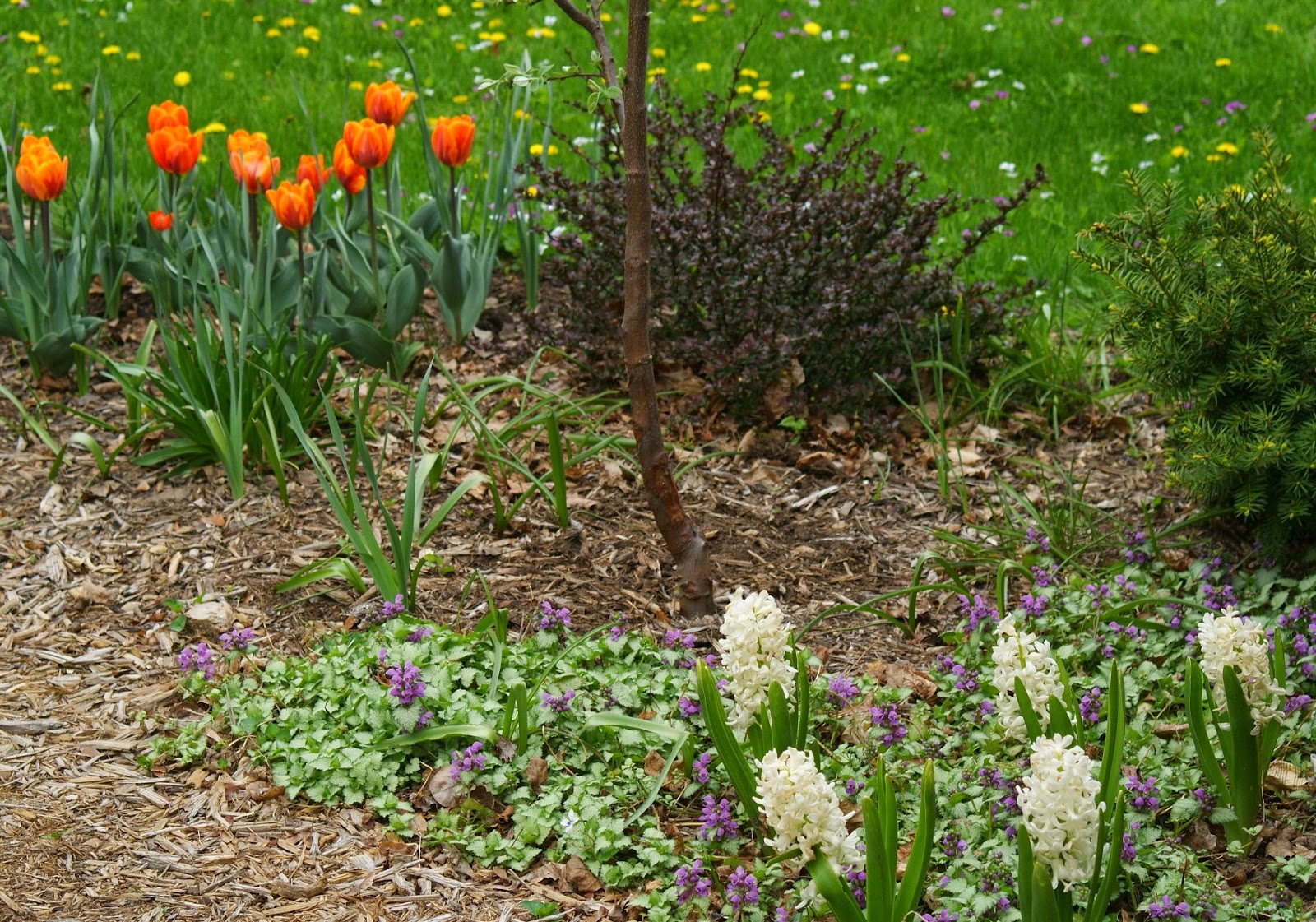
'Princess Irene' Tulips, Hyacinths, Lamium, and Barberry

Another patch of 'Princess Irene' at the back corner of the Rose Garden. Here it contrasts sharply with the dark new leaves of Barberry 'Crimson Pygmy'. As you can see the White hyacinths are still going strong, and Lamium 'Orchid Frost' has begun to bloom at the foot of my young quince tree. It creeps and expands fairly rapidly, but is not hard to pull out.

Mid May: 'Princess Irene' Tulips, Lamium 'Orchid Frost'

Here is the same area from a different angle, a few days later. Lamium is now in full bloom, the barberry begins to glow, and the quince has fuzzy gray new leaves. Clematis vines start their ascent of the trellis (which needs to be painted!) in the background. The small yew (which needs a trim!) also puts on a new flush of growth.

Mid May: Tulipa humilis and Spurge

Meanwhile, in another corner, another early tulip has begun to bloom. This is the tiny species tulip 'Little Beauty' (Tulipa humilis). Unlike standard tulips, this type has unobtrusive, grass-like foliage that dies away almost imperceptibly when its time has come. The blooms are little but very cute. They are bright enough to stand up to the intensity of the Euphorbia in full glory. They also look good near my purple smoke bush (Cotinus coggygria 'Velvet Cloak'), which begins to leaf out now. The jewel-toned leaves of this shrub look fabulous from spring to fall. I cut it back to the ground every year to keep it small - otherwise it grows into a rather large tree. The dwarf conifer here is a fir - Abies balsamea 'Piccolo'. I will probably have to move this soon as it is too close to the Cotinus - hopefully I will manage to do this without killing it in the process!

Late May: Spurge and 'Little Red Gem' Peony

Finally, at the end of May my 'Little Red Gem' peony blooms. This is a so-called "Rock Garden" peony, which is a hybrid of several small European species peonies. It is much smaller than the Chinese Paeonia lactiflora types, and appears to have some fernleaf in its blood, judging by the fine foliage. It is my earliest herbaceous peony to bloom.

Late May in the Rose Garden: Peony 'Little Red Gem' and 'Princess Irene' Tulips

'Little Red Gem' is not really red - more of a deep pink. A lovely color that stands up well to the bright tulips and spurge which bloom with it. The rose behind it is a large, exuberant Rosa alba. It is very hardy and one of my earliest roses to leaf out in spring. At its feet, some dwarf Catmint (Nepeta 'Little Trudy') are just beginning to show color along the edge of the border.

Next up: June, and some actual roses!


Monday, May 20, 2013

Late May stroll

It's mid-May. The loud flush of spring bulbs is over, and now it is time for the softer flowers of perennials and shrubs to take center stage.

In this shady corner at the back of my house, the fothergilla has begun to bloom, surrounded by lamium and some hostas.

Fothergilla major 'Mt. Airy', Lamium maculatum 'Orchid Frost', unknown hosta
The fothergilla is still a toddler - it should grow to a glorious 6-8 feet of splendour, eventually. Here is the same shrub from another angle. Here you can see the rhubarb across the path, with a clematis vine creeping through them.

Fothergilla major 'Mt. Airy', Lamium maculatum 'Orchid Frost', hosta, rhubarb
Here is another shot of the same lamium, blooming incredibly heavily in a sunnier spot. Lamium grows well (sometimes too well) pretty much anywhere, but bloom is better in the sun.

Lamium maculatum 'Orchid Frost'


The large old lilac "shree" (=shrub/tree) is also going strong, filling the air with perfume. This is the best bloom I've seen on this old fellow yet. Perhaps he likes the compost and mulch I gave him, after many years of neglect.
Lilac in bloom

In the sunny front rose garden, Euphorbia polychroma (Cushion Spurge) is blooming with an early fernleaf hybrid peony.

Euphorbia polychroma (Cushion Spurge) and Peony 'Little Red Gem'
Here is the peony closer up. It was just planted last year so is still quite small. The fernleaf foliage is fantastic. Unlike the straight fernleaf species peonia tenuifolia, this hybrid will supposedly retain its foliage through the summer. We'll see!
Fernleaf hybrid peony 'Little Red Gem'

Another early peony is also blooming. This one is the Mediterranean species paeonia mascula. It has large-textured foliage and gorgeous deep pink flowers. (The picture was taken after a heavy rain, so the flower is unfortunately a bit battered. Naturally, a peony must open just before a storm!) This is the first spring in my garden for both these peonies, so I am pleased that they bloomed.

Paeonia mascula
My iris cristata (Crested Iris) have also begun blooming. This photo is a major macro - the flowers are tiny, about one inch across at most. The cool blue color carries across the garden despite the small size, and the short, grassy foliage remains neat and perky all season.

Iris cristata (Crested Iris)
The shady strip at the side of my house is now flush with the expanding foliage of ferns, heuchera, Solomon's seal, and a dwarf oakleaf hydrangea. Bleeding heart and bergenia are blooming.

Blooming: bergenia cordifolia 'Winterglow', dicentra spectabilis


Saturday, November 10, 2012

Fall Color

I love fall color in the garden, and am always trying to incorporate more plants with this dimension. Here are a few that we enjoyed this fall:

Fothergilla major

Fothergilla major 'Mount Airy' - fall color

The fothergilla is definitely my favorite! Mine is still young but already looks awesome in fall. (Can't wait for 6-8 feet packed with that color!) The leaves turn quite late, after most trees are already bare.

Bergenia (Pigsqueak)

Bergenia cordifolia 'Red Beauty' - fall color

I have three different cultivars of bergenia and they all had different colored foliage in fall. This one, 'Red Beauty', had a brilliant coral-pink-red color. 'Pink Dragonfly' turned a brilliant ruby, and 'Winterglow' was more of a burgundy. (They are all located in different parts of my yard, so some of the color differences may be due to sunlight or location rather than cultivar, I'm not sure.) I enjoy all of them - for their early spring flowers and glossy green summer foliage as well as the fall reds!

Geranium wlassovianum

Geranium wlassovianum - fall color

This unusual geranium blooms in late summer, then turns gorgeous colors in very early fall (September here). However, it appears to be quite frost tender and got zapped by the first light freeze. Being in the north, I'm not particularly fond of plants that shrivel that early. But I like this little guy enough to forgive its one fault.

Geranium sanguineum var. striatum (Bloody Cranesbill)

Geranium sanguineum var. striatum - fall color

The leaves of this geranium gradually turn dark red in fall, and hold long past frost. It even has one cute little flower still on it (in mid-November), as you can see in the picture!

Geranium macrorrhizum (Bigroot Geranium)

Geranium macrorrhizum - fall color

Quite a few of the geraniums have great fall color. Geranium macrorrhizum (Bigroot geranium) also retains its large fuzzy leaves long into the cold months, and turns a rainbow of soft colors in fall.

Rosa virginiana

Rosa virginiana - fall color

This native American species rose has awesome fall color. It started out early with crazy fireworks of bright yellow and orange, then faded to this intense plum red by November. Definitely a keeper!

Hydrangea quercifolia

Hydrangea quercifolia 'Little Honey' - fall color

This dwarf oakleaf hydrangea has chartreuse foliage in summer, followed by burgundy in fall. The color is somewhat muted, but still a wonderful transformation to observe. My poor little guy got eaten back to the base last winter and I thought it was a goner - amazingly, it's grown over two feet this year and seems to have completely recovered. (It didn't bloom though - the buds presumably got destroyed.) I love the chunky yet fancy leaf shape.

Mahonia aquifolium (Oregon Grapeleaf)

Mahonia aquifolium - fall color

This little shrub is an evergreen, but the very glossy, dark green leaves of summer turn a dark burgundy-brown in the cold months. The leaves are prickly and shaped somewhat like a holly, but unlike holly it does not require acidic soil (which I do not have). It will also grow happily in even a fair amount of shade and is supposedly drought tolerant.

Friday, April 20, 2012

Lilacs at the Arboretum

It's lilac time here in Wisconsin, so of course... off to the Arboretum I go!

Lilacs blooming at the Arboretum

The UW-Madison Arboretum has an awesome collection of hundreds of lilacs in all shapes, sizes, and colors. The mid-season lilacs would normally bloom here in May, but in this odd year of 2012 are at their peak in April. Here were some of my favorites - these are all cultivars of syringa vulgaris (aka common lilac or French lilac).

Syringa vulgaris (common lilac) 'Henri Martin'
My favorite color of lilacs is... well - lilac! 'Henri Martin' has big beautiful double flowers in a rich shade of that classic lilac color. I gave each lilac a sniff as I strolled through the gardens, and I noticed that not all lilacs have the same fragrance. Some have a flat, almost unpleasant scent, and some have no detectable fragrance at all. 'Henri Martin' had the sweetest, most powerful fragrance of all I encountered - my nose wanted to live in this flower!

Syringa vulgaris (common lilac) 'Paul Deschanel'
I also really love the dark purple cultivars. I saw quite a few standouts - 'Declaration', 'Prince Wolkonsky', 'Yankee Doodle'. 'Paul Deschanel' had gorgeous mulberry colored buds and was perhaps my favorite in this color class.

Syringa vulgaris (common lilac) 'Marie Frances'
There are not many pink lilacs. Some that are called "pink" are really more of a pink-ish violet color. 'Marie Frances' had true pink flowers of an otherworldly delicate beauty.

Syringa vulgaris (common lilac) 'Mount Baker'
White lilacs can be very elegant. 'Mount Baker' and 'Edith Cavell' were my favorite whites, but 'Mount Baker' had a much more powerful fragrance. The bush was absolutely covered with exuberant blooms.

Syringa vulgaris (common lilac) 'Primrose'
There are no truly yellow lilacs, but 'Primrose' is a soft cream color with yellowish buds. It's a nice soft color for a spot where pure white might be too harsh or glaring. It sets off other more traditionally colored lilacs nicely.

Syringa vulgaris (common lilac) 'Martha Stewart'
I loved the cool gray-blue shade of this 'Martha Stewart' lilac. This is also an unusual color in lilacs.

Syringa vulgaris (common lilac) 'Emile Lemoine'
'Emile Lemoine' is a gorgeous lilac - full soft double flowers of a pearly pinkish lavender. It just looks so French, doesn't it?

There were dozens more beauties, and I probably only managed to see 1/3 of the vast collection... I returned home to my own lilac, looking so ordinary and unexotic there all by himself in the corner of my yard... But even the basic syringa vulgaris var. purpurea puts on a great show, and it actually has a more powerful scent than most cultivars!

My own lilac - basic syringa vulgaris var. purpurea

Related Posts Plugin for WordPress, Blogger...